Remember when page one was the goal? Lots of people now never get there. They read the little answer box at the top, glance at the sources under it, and move on. If you’re not in that list, the customer doesn’t know you exist.
I’ve watched these tools for a while, and the way they pick sources is less mysterious than people make out. Some call the practice generative engine optimization, others call it answer engine optimization. Either way, here’s what’s going on and what you can do about it.
How these tools pick their sources
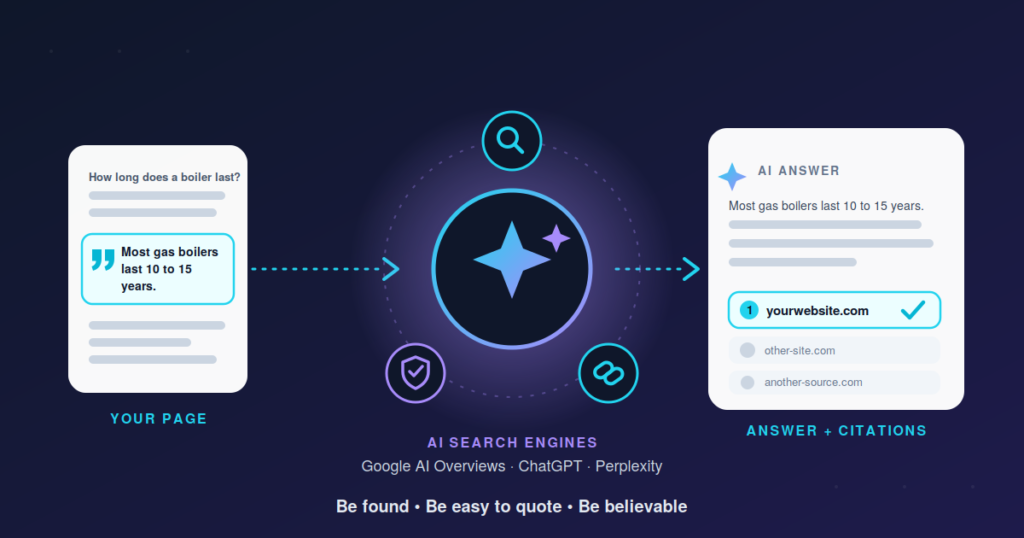
You can ask Perplexity or ChatGPT a question, and it will respond with reasoning, not by rote-learned answers. It splits your query into smaller queries, finds the snippets that seem useful and assembles an answer. Google’s v AI Overviews work much the same way.
Two things follow from that. First, they don’t quote pages, they quote a paragraph and one good paragraph can outperform a 5,000 word guide that never says anything out loud. Secondly, if you are not found, you cannot be quoted. It is still important for you to be crawlable and have normal search rankings.
VEWD vNow there are three tasks that remain: to be found, to be easy to quote, and to be believable.
Get found
Boring stuff first. Read your robots.txt. If Googlebot, OAI-SearchBot or PerplexityBot are blocked, you’ve told them not to bother. Plenty of publishers block AI training crawlers on purpose, and that’s fair. Blocking the search crawlers is a different thing, and it costs you citations. Perplexity lists exactly what its two crawlers do, and it’s worth a quick read before you change anything.
Blocking the search crawlers is another thing and is a loss of citations.
Make sure that your main text is not in the text format. There are certain AI crawlers that don’t even execute javascript, hence if the page is being built in the browser, then for these crawlers the page may appear to be blank. Make sure your sitemap is organized, and add the date to the article if it’s updated. If bots continue to be bounced back to dead pages or blocked URLs, the first step is to fix crawl issues.
Make it easy to quote
Put the answer first. Under a heading phrased like a question, give the direct answer in two or three sentences, roughly 40 to 60 words. Then explain.
Write headings the way people type. “How long does a boiler last?” beats “Considerations on boiler lifespan.”
Let each paragraph stand alone. “As mentioned above” means nothing once a passage is lifted out of the page. Just name the thing again.
Here’s what that looks like in practice. A plumber’s page opens with “Boilers are an important part of any home and there are many factors to consider.” Nobody will ever quote that. Instead: “Most gas boilers last for 10 to 15 years, and if yours is at the end of its service life and problem prone, replacement is often more cost effective than repair. That’s a line that a computer or algorithm can learn and apply.
Be believable
Original data is the strongest thing you can offer. A tiny bit of surveying, a test of your own, some real examples: wherever the model doesn’t find them.
Include the names of the author(s), some biographical information about them, an about page, and links to primary sources. Then check out other sites. These tools will cross check, mentions of a product in trade press or Reddit threads, and in YouTube videos are all helpful. A brand that has no other blog will sound like it’s talking to itself.
A worked example
Take a small accounting firm that wants to be the answer to “Do freelancers need to register for VAT?” Their post is called “Everything You Need to Know About Tax.” It runs 3,000 words and mentions the registration threshold in paragraph nine. It’s accurate, and nobody will ever quote it.
So they retitle it with the exact question and open with a two-sentence answer: freelancers register once taxable turnover passes the threshold in a rolling 12 months, and below that it’s voluntary. Underneath they add a small table comparing the standard and flat-rate schemes, a worked example with real figures, a “last reviewed” date, and a short bio of the chartered accountant who wrote it. Then they publish a brief write-up of how their own freelance clients fared on the flat-rate scheme.
Nothing clever there. But the page now has a clean answer, a visible expert, a date, and data nobody else has.
Keep track of what works
Pick 20 questions your customers really ask. Once a month, run them through Google, ChatGPT and Perplexity and note who gets cited. A spreadsheet is fine. Then copy what the winners do.
FAQs
Is this replacing SEO?
No. SEO decides whether you’re retrieved at all. This is about being the passage that gets picked once you’re in the running.
Do I need schema markup?
Not strictly. It helps a little, and clear writing helps more.
How long until I see results?
Perplexity and ChatGPT can learn new and crawlable pages within days. Google AI Overviews follow your ranking, so plan for the weeks and months.
Should I block AI crawlers?
That’s your call. Blocking search crawlers means no citations from them. Many sites block only the training bots.
Can a small site win?
Yes. Passages get quoted, not brands, so original data or real niche knowledge can beat bigger sites on specific questions.
Final thought
It’s not a trick, it is a fact. The sites that continually pop up answer the question directly, back up their answer and have something worth repeating on the page. You don’t have to do it all at once either. Choose one page this week, repeat the opening and answer the question in two or three sentences – add a date and an author – and then check back next month to compare what has changed. Write to the person who’s asking, and the citations follow.