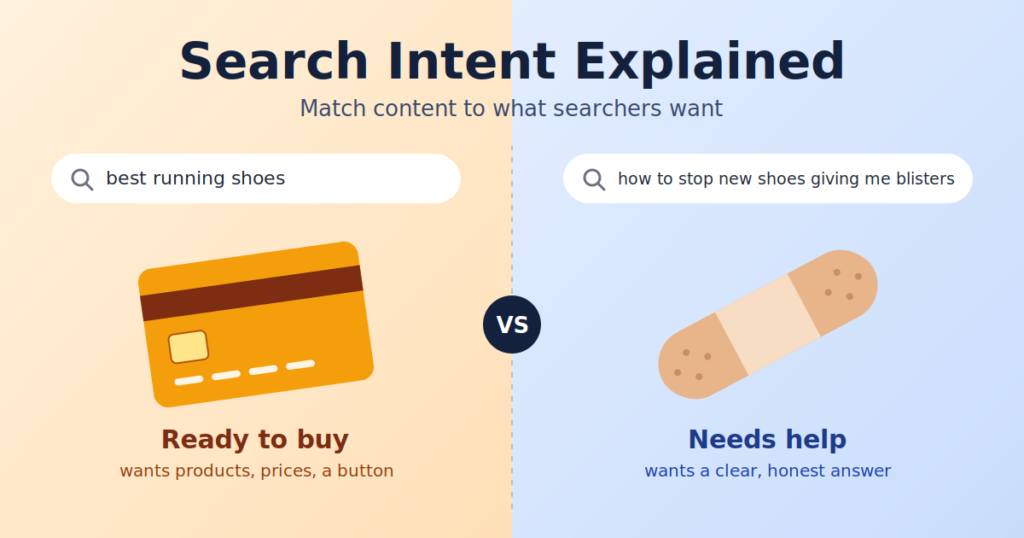
Open Google and type “best running shoes.” Now type “how to stop new shoes giving me blisters.” Same neighbourhood, right? Feet, running, shoes. But the two people behind those searches are in very different places. One has a credit card in hand. The other has a sore heel and a bad mood.
That difference is search intent, and if a site is stuck, it’s the first thing I’d check. You can have tidy titles, fast pages and a pile of backlinks, and still go nowhere if the page doesn’t give people what they came for.
What Search Intent Actually Means
It’s the why behind a query. Nobody types into Google for fun (okay, almost nobody). There’s always something they’re trying to get done, and Google has become scarily good at guessing what. If you want the background, Google explains how Google Search works in its own documentation. Line your page up with that and you get rewarded. Miss it and you end up on page four wondering what went wrong.
Skip “what keyword do I want?” and instead ask this question: What is he/she wanting to be holding 30 seconds from now?
The Four Kinds of Intent
SEO people sort searches into four boxes. The boxes leak a bit, but they’re good enough to work with.
Informational
Someone wants to understand something. “Why does my phone battery drain overnight?” “What is a Roth IRA?” They aren’t spending money today. Simply tell them a proper response and a couple of instances, and avoid a hard sell. If you’re there to assist, they may remember your name later.
Navigational
They know exactly where they’re going and Google is just the shortcut. “YouTube Studio.” “Gmail login.” Unless it’s your own brand, forget these. You won’t outrank the real site, and you shouldn’t waste a week trying.
Commercial Investigation
This is the interesting middle. The person will probably buy soon, but they’re nervous about picking wrong. “Best budget laptops for students.” “Notion vs Evernote.” “Dyson V8 review.” What they need is someone they can trust who has already tried and tested all of that and points out to them, take a different one, choose this one. Honest reviews and comparisons are a good fit here, as are clear trust signals that indicate that they are backed by actual people.
Transactional
The wallet is out. “Buy running shoes online.” “Book flights to Dubai.” “Canva Pro free trial.” Don’t make these people read. Give them the product, the price and a button.
Working Out What a Keyword Really Wants
Words give hints. “How” and “why” usually mean someone is learning. “Best,” “vs” and “review” mean they’re comparing. “Buy,” “price” and “coupon” mean they’re ready.
Plenty of keywords are slippery, though. “Standing desk” might be a person reading up on back pain, or someone about to check out. The words won’t settle it. The results page will, which brings me to the actual method.
How to Match Your Content to It
Read Page One Like a Detective
Google your keyword, and don’t just skim. What are the top ten? Listicles? Product grids? A couple of videos? Google didn’t pick those at random. It watched what people clicked and what sent them straight back, and these are the survivors. If all the above is a “best of” list and you’ve already written a 4000 word history, you’d probably want to rethink your plan.
Choose the Format Before the Words
“How to tie a tie” is a video. Obviously. No one would want to read a paragraph of loops and tails. Recipe ingredients should be at the top, not a story about your Grandmother’s Kitchen, (yes, I know). Adopt a guide, a list, or a tool or product page.
Say the Answer First
Search “how long to boil an egg.” The best results tell you about ten minutes for hard-boiled in the very first line. Soft yolks and altitude come after, for the people who care. Treat your pages the same way. Earn the scroll.
One Page, One Job
I see this constantly: a page that teaches, compares five products and tries to sell, all at once. It ends up mediocre at everything. Split the jobs up and link between them. The guide leads to the comparison, and the comparison leads to the product. Building this structure on purpose is what a topic cluster is all about.
Two Searches, Same Topic, Different Pages
Take “coffee grinder.” The results are mostly shopping listings and roundups with titles like “7 Best Coffee Grinders.” The intent is buying, so an essay on burr geometry wouldn’t stand a chance.
Now try “how to grind coffee without a grinder.” Completely different page one. Short tutorials, mostly. A blender, a rolling pin, a mug and something heavy. Same bean, different mood. If you ran a coffee blog you’d write both, just never on the same page.
Mistakes I’d Avoid
- Picking keywords by search volume alone without checking what’s ranking
- Writing for the robot and ending up with stiff copy nobody enjoys
- Forgetting old posts, even though intent drifts and a query that wanted articles in 2020 may want videos now
- Cramming every intent into one page
FAQs
What is search intent in simple words?
It’s what a person is really after when they search. The words they type are just the surface.
Does it really affect rankings?
Yes. Google aims to please their users by letting them leave the search page with a smile. If your page is the purpose, individuals tend not to leave, so that helps.
Can one keyword have two intents?
All the time. “Jaguar” could be a car or a cat. “Yoga mat” could be research or shopping. Look at the results and you’ll see which meaning Google thinks is winning.
How often should I check old pages?
Once or twice a year, in those years that matter. As soon as traffic suddenly starts to drop and you’re unable to come up with a reason.
Which type is most valuable?
Depends on what you are selling. Transactional search is the fastest growing but the trust that gets there is being earned through informational and commercial content.
Final Thoughts
None of this is a trick. Whether it’s about paying attention to the other person on the computer screen or not. If they want to do something, work out in your mind what it is, and give it to them, without them having to dig.
Repeat it many times and you will get rankings. You stop writing for an algorithm and start writing for people, which is what the algorithm is chasing anyway.