Something odd is going on in search right now. Many of the sites writing about AI search seem the least prepared for it. Their advice is “be original,” “show expertise,” and “answer questions clearly,” yet few of those articles do any of it.
So I stopped reading advice and ran tests. Over three months, I changed 14 articles: I refreshed old ones, restructured new ones, added my own data, and cut keyword-stuffed sections. Some results surprised me, and one test went wrong. I’ll get to that one.
Treat this as field notes, not a framework.
What I found
Small, narrow sites may have an edge here, though my evidence for that is thinner than for the rest. I say so in that section.
Three of my top-ranking articles lost more than half their clicks without losing a single ranking position.
The traffic wasn’t penalized. It was pre-empted by AI summaries.
ChatGPT, Perplexity and Google AI Overviews each favored different kinds of pages.
Articles with my own data and documented failures got cited more than polished “ideal scenario” articles.
Technical fixes helped AI read my pages, but they didn’t make anyone want to cite them.
Table of Contents
What changed in my numbers
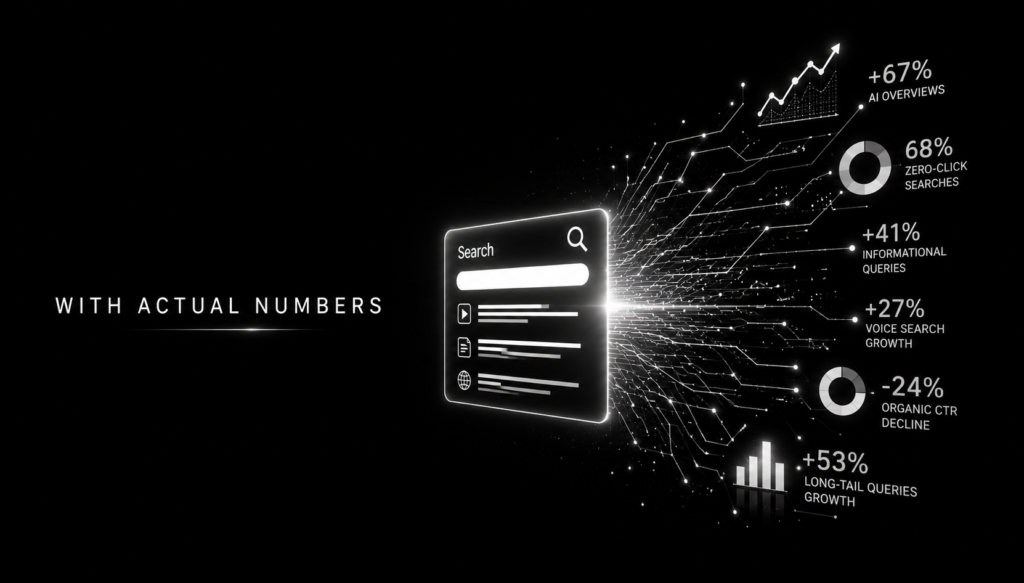
Three of my informational articles used to pull 1,200 to 1,800 visits a month each. In early 2024 they dropped below 600. They still held the top spot and were still on page one. Nothing had changed on the ranking side.
I went through my Google Search Console report and my session recordings. Impressions and positions looked healthy, but clicks had fallen. Visitors who did arrive skipped the intro and jumped straight to a specific section. They also spent about 40% less time on the page than the year before. They weren’t finding the topic through my article. They showed up already knowing the basics, most likely because an AI summary had covered them.
That’s not a penalty. There was a pre-emptive content. It depends on which penalty or pre-emption you are looking at, as there is a technical one and an editorial one that needs to be fixed.
The real competition isn’t other websites
SEO taught us to think of competition as a ranking contest. My page against yours, one gets position one.
Now the competitor is an AI system and it can answer the question without having to visit anyone. It is easy for it to compile dozens of sources into definitions, basic explanations and how-to steps. If your article is mostly a definition, you’re competing with an answer that never sends a click.
Where does AI still struggle? When I first wrote this I listed recency, but I need to correct that. Many AI tools now pull live web results, so “AI training data is old” is a weaker argument than it was. These gaps still seem real to me:
- Specificity. “How to improve engagement” is easy to answer. “How to improve engagement in a B2B SaaS onboarding flow with seasonal traffic” isn’t.
- Debatable positions backed by evidence. AI can cite them but can’t produce them.
- First-person experience. “I tried this and here’s what happened” can be quoted, but it can’t be faked.
That’s where I’d put editorial effort.
Why AI picked some of my pages and not others
I kept an eye on which updated articles showed up in ChatGPT (with browsing on), Perplexity and Google AI Overviews. They didn’t behave the same way.
| Platform | What it seemed to favor |
| Perplexity | Clear sections, direct answers near the top, cited data (even my own testing) |
| Google AI Overviews | Pages already ranking well, first-person language, author credentials, concrete examples |
| ChatGPT (browsing) | Comprehensive pages that covered edge cases, mistakes and contradictions |
I tracked this informally and didn’t keep an exact count, so read these as patterns I noticed, not measured rates.
These are three different audiences. An article tuned only for AI Overviews may do poorly on Perplexity, so find out which platform your readers actually use before you decide how to write.
What gets ignored
“Avoid thin content” isn’t useful advice. Here’s what thin looked like on my own pages.
Spending the first 40% defining things. If your first 600 words explain what GEO is and why search is changing, a reader who knows that leaves, and an AI that can write those words itself skips you.
Claims with no evidence. “Original data improves AI visibility” is just a statement. “I added a survey result to several articles, and some began appearing in Perplexity citations within a couple of months” is something a reader can weigh, especially once you add your own numbers.
Long but not complete. I’ve audited 2,000-word “complete guides” that covered one angle and skipped the exceptions and failure cases. Length isn’t depth.
Keyword stuffing. Repeating the target phrase four times in four slightly bent sentences reads badly to people and, in my experience, to machines too. When I cut those sections from several articles, I didn’t see a clear change in rankings or traffic, but the pages read better, and I’d do it again.
How to actually create original material
“Be original” is useless on its own. Here’s what worked for me.
Run a small test. You don’t need a 10,000-person survey. One strategy tried on ten articles gives you results nobody else has.
Publish your failures. The internet is full of wins. When I wrote up an internal linking strategy that did nothing after 60 days, it got more discussion and more backlinks than my success stories.
Take a position people can argue with. If your whole article fits in two bland sentences, an AI can summarize it, and then nobody needs to read it. A clear stance is harder to flatten.
Connect two things people don’t usually connect. My most-cited section linked content decay in informational articles to seasonal shifts in search behavior. Neither idea was new. The link between them explained a real traffic pattern.
The experiment that didn’t work
This is the test I promised. I took an existing informational article and reworked it around keyword placement and on-page structure: tighter headings, the target phrase in the right spots, a cleaner layout. I expected better visibility and more organic clicks.
Neither happened. I gave the page 5 weeks to be crawled and re-evaluated before judging it, rather than assuming it had failed right away. After that time, clicks, impressions, and rankings were all roughly unchanged. The lesson was that better keyword targeting alone doesn’t guarantee more traffic, especially when search results already give strong answers. I had polished the packaging without adding anything new.
If I ran it again, I’d put the effort into first-hand information, original observations, and something useful that competing pages don’t already offer.
Technical structure: necessary, not enough
It’s a good page for AI to read when headings, loading speed, HTML and schema are clean. They don’t give it a reason to cite you. Treat them as the baseline.
The few changes that did seem to matter:
- First, the answer, second the context. Make each section stand on its own and answer one specific question.
- Name your sources inside the sentence. Keep each section stand-alone and answer one question only.
- Only link where it makes for the reader. Not for crawl depth.
- Say what you updated and when. “Updated June 2025 to add Perplexity citation patterns” beats a silently changed timestamp.
A hypothesis worth testing: smaller sites may have an edge
I haven’t tested this one, so treat it as my reasoning, not a result.
Large sites tend to publish broadly, at medium depth. Small sites often go deep out of necessity. My guess is that a site with 30 detailed articles on one narrow niche could be better placed for specific questions than a site with 3,000 shallow ones. That may hold across niches like SaaS, finance and health. A focused site built on first-hand knowledge could earn trust before it has much traffic, which matters if you’re still working out website monetization strategies for a new site.
If I’m right, chasing volume is the wrong move. I plan to test this and share what I find.
Limits of what I did
I tested 14 articles over three months, with no control group. I can’t prove any single change caused any single result. Additionally, platforms evolve in their behavior all the time, so some of this may not be applicable in six months. These are observations NOT rules.
Where I think this is going
I’m wary of predictions, but a few things look likely.
Unique experience and private data will get more valuable as generic content gets easier to produce. Treating every AI platform the same will cost you visibility on each. And updating good articles will probably beat publishing new ones, because accuracy builds up over time in a way a fresh post can’t match.
The question below everything else remains the same: Is your content adding something that can’t happen without you? If the answer is “no” go there if it is honest.
Quick FAQs
What’s the difference between GEO and SEO?
Your page ranks better with SEO. When AI creates an answer from your content, GEO will assist in its use. They intersect, but SEO has to rely on coverage, keywords, and GEO relies on specifics, original content, and firsthand evidence.
Do all AI platforms use the same sources?
No. In my tests, Perplexity favored structured, cited content, AI Overviews leaned on existing organic strength, and ChatGPT liked pages that covered edge cases.
Can a small site compete?
Yes, especially on narrow questions that need depth.
Is there content GEO can’t save?
Generic content. If this information is duplicated on dozens of other sites, no technique would be of help.
How long does it take?
Engagement changes showed up within 2 to 4 weeks. Citations were slower: some in 6 to 8 weeks, others later, and a few still haven’t appeared.
One last thing
This article is itself a test. I tried to write it the way I’d tell you to write yours: real numbers, a failure next to the wins, a position, and firsthand observation. Whether it earns citations rather than just clicks, I don’t know yet.
If you want a starting point, try this: pick one article, add something only you could know, say what you changed and when, and check back in two months.