
You hit publish. You waited. Nothing happened. Google’s acting like your page doesn’t exist.
If that’s you right now, you’ve probably typed “how does SEO work” into a search bar at some point in the last week, hoping for a straight answer instead of another article telling you to “create quality content” without explaining what that even means in practice.
Caution: SEO is not a switch that you flip on or off. It’s more of a domino effect. A search engine has to find your page, read it, decide it’s worth keeping around, and then decide it’s worth showing people — and that’s before anyone has clicked on anything. Miss a step anywhere in that chain and it doesn’t matter how good your writing is.
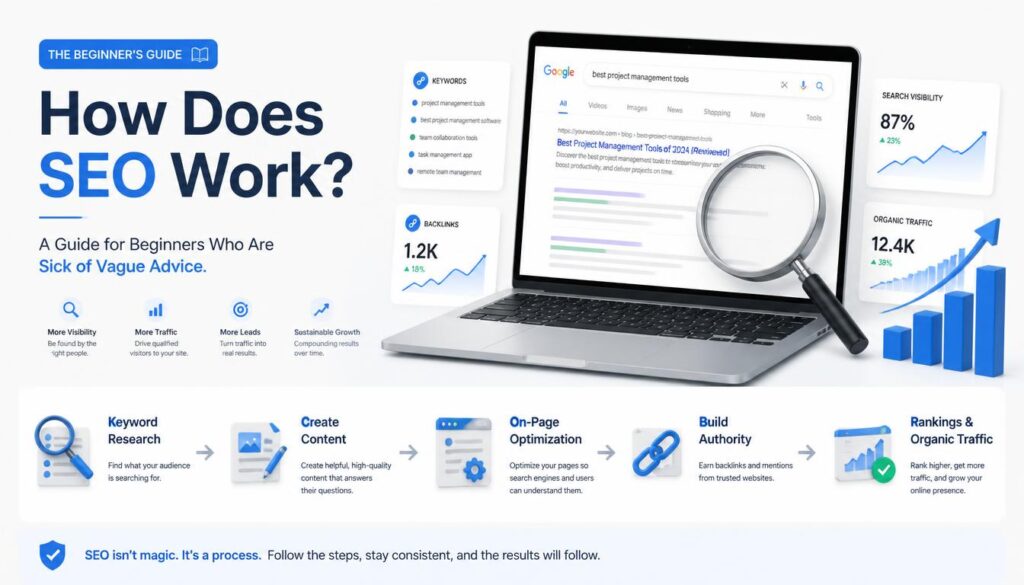
Fortunately, you don’t have to be a genius in Google’s algorithm to get moving. The basic process you need to know is discovery, crawling, indexing, ranking and traffic. That’s it. Let’s actually walk through it.
Okay, But What Is SEO?
SEO: Search Engine Optimization – put simply: make it easier for search engines – and the people that use them — to understand what you’ve got on your site and why it’s important.
Suppose you are a marketing blogger and publish an article titled “How to Do Keyword Research. Somewhere, someone searches “how to find keywords for SEO.” If your article actually answers that, and Google can access it without a fight, and it holds its own against everyone else writing about the same thing — you’ve got a shot at showing up.
That last part trips people up. You’re not just writing for a reader. You’re competing. Every article on that topic is auditioning for the same spot.
SEO usually gets split into three buckets:
- On-page SEO — the actual content: headings, wording, internal links, whether you’re answering the right question.
- Technical SEO — can search engines even crawl and read your site properly, or is something in the way?
- Off-page SEO — the reputation you build through other sites linking to you or mentioning you.
The Five Things That Actually Happen
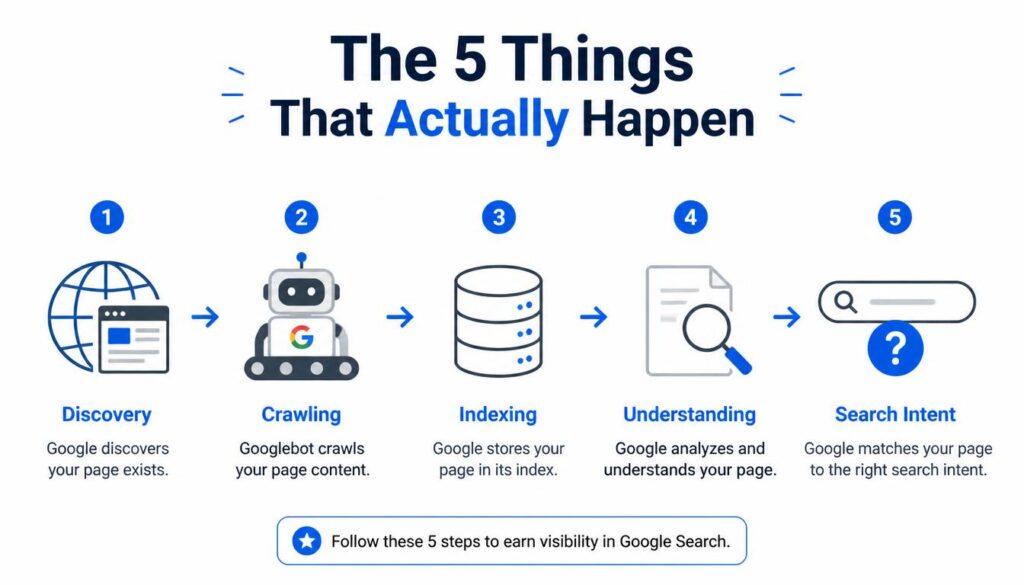
1. Discovery: Google Has to Know You Exist
Nothing moves until a search engine finds your page. Crawlers (bots, essentially) discover new pages by following links from other pages, reading sitemaps, or picking up on other signals floating around the web.
Consider your site like a new coffee shop that opened in a city where there are no signs and no roadways to it. Doesn’t matter how good the coffee is — nobody’s finding it by accident. Hence, it is true to say that internal linking is more important than people consider. When you have a great page that’s 5 clicks away with no links that lead to it, you are essentially hiding it.
2. Crawling: Google Shows Up and Looks Around
Once Google knows a URL exists, it might send a crawler over to actually fetch the page and everything on it.
This is usually where things quietly fall apart. A blocked page. A server that throws an error. A site that’s a mess to load. These are all forms of crawl errors, and any one of them can stop the crawler before it ever gets to read your actual words. You can write something great and still lose right here, before content quality even enters the conversation.
3. Indexing: Google Decides If It’s Keeping the Page
People mix up crawling and indexing constantly, so let’s be clear.
Crawling means Google visited the page. Indexing means Google decided to actually store it.
This is the step that quietly ruins a lot of beginners. You can write something genuinely good, and it can just… not show up anywhere. Not because it’s bad. Because it never made it into the index in the first place. Getting indexed doesn’t mean you’ll rank well — it just means you’re finally in the room.
4. Understanding: Google Tries to Figure Out What You’re Even Talking About
Once a page is crawled and processed, Google works out what the page is actually about — and no, that’s not the same as counting how many times you used your target phrase.
If you are writing an article about how does SEO work, then there are a lot of things that you should be covering that will make your article a useful and valuable one to read.When writing an article on how does SEO work, there are a lot of things to include in the piece that will make it valuable to read and useful to people who are just starting. Saying thirty times is not going to do any good. Actually covering the topic will.
5. Intent: Are You Answering the Right Question?
This is where a lot of decent content quietly falls flat — it ignores why someone searched in the first place.
- “What is SEO?” — someone wants an explanation.
- “SEO agency near me” — someone’s looking to hire.
- “Buy SEO software” — someone’s ready to spend money.
Beware of showing a sales presentation to someone that needs to be explained, it doesn’t matter how great the presentation looks it will not work. Before you begin writing the first word in the answer, make an attempt to figure out the question to which the keyword is the answer.
What Actually Affects Rankings
There’s no secret lever. It’s a mix of signals, and here’s what tends to matter most.
Content quality. Actually solve the problem. A tight, honest 900 words beats a padded 3,000-word wall of filler almost every time. Nobody’s impressed by length for its own sake — least of all Google.
Relevance. If you have a title that reads “SEO for beginners” but the article is focused on enterprise strategies and methods, you’ve got the wrong article for your target audience.
Site experience. Pages should load without making people wait, and they should work on a phone without falling apart. Good technical performance won’t save weak content — but bad performance will absolutely sink good content before anyone gets to read it.
Internal links. Your beginner’s SEO guide should link to your deeper keyword research article. That article should link back. It’s good for readers, and it hands Google extra context about how your site is organized.
Backlinks. One link from a site people genuinely trust is worth more than fifty links stitched together to game a system. Build real authority. Don’t just chase a bigger number.
A Practical Starting Point
Don’t try to fix everything at once — you’ll burn out before you finish step two. Here’s a reasonable order:
- Pick a real topic. Something your audience is actually typing into Google, not something you assume they care about.
- Figure out the intent. What does someone expect when they search this exact phrase?
- Write something worth reading. Real answers, real examples, your own take on it.
- Optimize the page. A clear title, sensible headings, natural keyword use, useful internal links, formatting people can actually skim.
- Handle the technical basics. Accessible, mobile-friendly, indexable, no glaring errors.
- Build some visibility. Share it. Earn mentions from places worth being mentioned by.
- Check the data and adjust. Google Search Console will tell you what’s actually happening — use it instead of guessing.
SEO isn’t a “publish it and walk away” kind of thing. You’ll revisit pages. You’ll restructure them. That’s normal, not a sign you did it wrong the first time.
So… How Long Does This Actually Take?
Nobody can give you a real number, and anyone who does is guessing. A brand-new site needs time to even get discovered, let alone crawled, indexed, and evaluated fairly against competitors who’ve been at this for years.
Think compounding, not overnight. One decent article might get you a handful of visitors this month. A cluster of well-connected, genuinely useful articles can turn into a real, steady stream of traffic a year from now — but it builds slowly, and there’s no shortcut around that.
Quick Questions People Actually Ask
Is SEO free? You’re not paying Google for a spot in organic results, but SEO still costs you time, research, writing, and sometimes tools or outside help. “Free” is relative.
Does SEO guarantee a first-page ranking? No. Anyone promising that is either lying or doesn’t understand how competitive search results actually are.
Is it just about keywords? No. Keywords tell you what people search for, but intent, quality, site health, internal structure, and trust all carry weight too.
Can a brand-new site actually rank? Yes — it just takes longer. New sites need to earn relevance and trust before they can compete with ones that have been around a while.
Technical SEO or content first? Both matter, but don’t hide behind technical perfectionism as an excuse to never publish anything. Get the basics working, then keep writing things that actually help people.
The Bottom Line
There’s no magic keyword density. No single trick that flips a switch and puts you on page one.
Pick something real to write about. Understand what the person searching actually wants. Write it well. Make sure your site doesn’t get in its own way technically. Link your pages together sensibly. Earn trust instead of manufacturing it. Then look at the data and keep adjusting.
Stop treating SEO like a trick for tricking Google. It’s really just the discipline of becoming the best answer to the question someone actually asked.