SEO agencies have a lot of repetitive tasks to handle on a day-to-day basis, such as keyword research, content briefs, technical SEO audits, client reporting, ranking, e-mail updates, and lead management. Manual work is sometimes a drawback as the number of clients increases. Lots of teams take hours on simple matters, rather than strategy and growth.
AI workflow automation is revolutionizing the SEO agency industry. AI should be used alongside SEO experts, rather than replacing them, as a tool to improve their workflow, efficiency, consistency, and speed in completing repetitive tasks. There is no need for agencies to hire additional people to work with more clients.
Many SEO teams observe the repetitive activities use more time than they anticipated, particularly as the number of client projects grows.
Table of Contents
- What Is AI Workflow Automation?
- Why SEO Agencies Need Automation
- SEO Tasks That Can Be Automated
- Real Workflow Examples
- Workflow Diagram for SEO Agencies
- Benefits of AI Workflow Automation
- Best Practices
- Conclusion
- FAQs
What Is AI Workflow Automation?
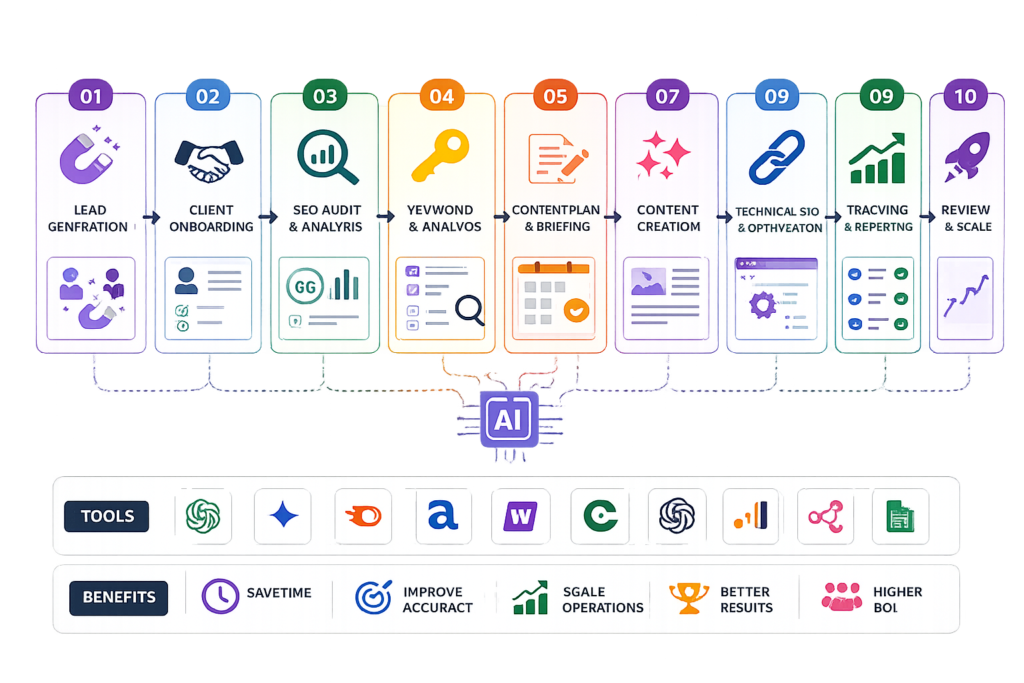
AI workflow automation is the idea of utilizing AI tools and linked systems to automate repetitive tasks with little to no human engagement.
In the case of SEO agencies, this implies developing systems in which one thing leads to the next.
For example:
A new client submits a form → CRM stores data → AI generates onboarding questions → project management software creates tasks → keyword research begins automatically → content briefs are generated.
Instead of switching between ten different applications manually, the system handles most repetitive work.
Why SEO Agencies Need Automation
SEO involves hundreds of repeated actions.
Typical agency challenges include:
- Creating reports for multiple clients
- Tracking keyword changes daily
- Managing content production
- Organizing outreach campaigns
- Handling client communication
- Performing technical site checks
Without automation:
- Human errors increase
- Teams lose time
- Scaling becomes difficult
- Productivity decreases
With automation:
- Processes become faster
- Work remains consistent
- Teams save time
- Agencies can manage more projects
Imagine an agency handling 40 clients.
If one report takes 30 minutes manually:
40 × 30 = 1,200 minutes
That equals 20 hours monthly just for reporting.
Automation can reduce this process to only a few minutes of review time.
SEO Tasks That Can Be Automated
| SEO Task | Manual Process | AI Automation Example |
| Keyword Research | Search keywords individually | AI finds related terms automatically |
| Content Brief Creation | Research competitors manually | AI generates outlines |
| Technical Audits | Review site page-by-page | AI detects issues instantly |
| Rank Tracking | Manual monitoring | Daily automated updates |
| Reporting | Build reports manually | Auto-generated dashboards |
| Client Emails | Write repeated updates | AI creates personalized drafts |
| Lead Qualification | Manual screening | AI scores leads automatically |
Real Example: My Content Workflow Experience
While working on SEO projects, I noticed that a large amount of my SEO work wasn’t actual SEO strategy. I was spending more time moving between tabs than creating content plans.
Whenever I started a new article, my process looked like this:
- Open keyword research tools
- Search competitor pages
- Collect headings manually
- Build an outline
- Create writer instructions
- Check optimization scores later
For a single article, this sometimes took nearly an hour.
After creating an AI workflow, things became much simpler.
Now my process works like this:
Article Topic Added
        ↓
AI collects keyword variations
        ↓
Competitor headings extracted
        ↓
Content brief generated
        ↓
Writer receives task
        ↓
SEO optimization check runs
Instead of jumping across five or six tools, most of the repetitive steps happen automatically.
Real Example: Reporting Took More Time Than Expected
I remember looking at my monthly workflow and realizing reporting had quietly become one of the biggest time-consuming tasks.
I would:
- Open analytics reports
- Export ranking data
- Take screenshots
- Add performance notes
- Create summaries manually
- Send everything to clients
The work itself wasn’t difficult. The issue was repetition.
When handling multiple projects, those small tasks started consuming hours.
After setting up automation, the process changed:
Traffic data updates automatically
↓
Keyword rankings sync automatically
↓
Charts generate instantly
↓
AI creates a performance summary
↓
I review and send
Now I spend more time analyzing results instead of collecting data.
Popular Tools Used in SEO Automation
Many agencies combine multiple tools together.
Common examples include:
| Tool Type | Examples |
| Workflow automation | Zapier, Make |
| SEO analysis | Ahrefs, SEMrush |
| Content optimization | Surfer SEO, Clearscope |
| Analytics | Google Analytics |
| Project management | Trello, ClickUp |
| AI writing assistance | ChatGPT |
They are all tools that are designed to work together to form connected systems, not tasks.
Benefits of AI Workflow Automation
Increased Productivity
Teams reduce the time they spend on repetition and focus on developing strategies.
Faster Client Delivery
Reports, content briefs, and audits can be completed much faster.
Better Accuracy
Automated systems reduce common human mistakes.
Improved Scalability
Agencies can manage larger client portfolios without dramatically increasing staff.
Stronger Client Experience
Faster communication and reporting create a smoother experience for clients.
Best Practices for SEO Agencies
Do not automate everything immediately.
Start with repetitive tasks first:
- Monthly reports
- Keyword tracking
- Content briefs
- Technical audits
- Internal notifications
Always check AI-generated content before publishing since AI should serve as a tool for human insight.
Develop workflow progressively and quantify benefits of automation before adding more.
Conclusion
AI workflow automation is a growing aspect of contemporary SEO practices. Businesses that have repetitive work automated are able to save time, boost consistency, and scale more efficiently.
The aim is not to get rid of human decision making in SEO. People are still needed for strategy, creativity and for building relationships. AI is about making repetitive tasks easier, letting your SEO team concentrate on growth and results.
Agencies with the expertise and savvy use of automation will be at a larger benefit as search marketing becomes more competitive.
FAQs
What is AI workflow automation in SEO?
AI workflow automation in SEO involves leveraging AI and integrated tools to automate repetitive tasks such as keyword research, reporting, content briefs, and tracking.
Can small SEO agencies use AI automation?
Yes. Small practices can automate the process of client reporting, content planning and keyword tracking without having to hire a large agency to do the work.
Which SEO tasks are easiest to automate?
Typical tasks that are automated include keyword research, technical audits, reporting, content briefs, lead management and client notifications.
Will AI replace SEO professionals?
No. While AI can minimize manual effort, SEO strategy, creativity, decision-making, and client connections demand human expertise.
What tools are commonly used for SEO workflow automation?
Tools that many agencies are using include ChatGPT, Zapier, Make, Ahrefs, SEMrush, Google Analytics, and project management platforms.
How does AI workflow automation save time?
Automation minimizes repetitive manual tasks by performing them automatically, enabling teams to concentrate on strategy and development.