
You’ve spent weeks creating pages, fine-tuning the design, editing each sentence of your content twice. You check your analytics and find your own traffic, but nothing else? Now you go to your analytics and you get one straight line at the bottom of the page at zero traffic, apart from your own.
Most advice tells you to wait. Traffic comes first, they say, and the money follows later. I don’t think that’s true, or at least not the whole truth.
Traffic helps, obviously. The more people that visit, the more money that is earned. But it’s not the only thing, and using your website as a traffic magnet isn’t the entire point of it—it’s supposed to be an asset that you can provide to address a problem for a specific person, and that’s on day one. With value instead of volume, you can make money before Google sends you any visitors.
Why “Traffic First” Trips Up Beginners
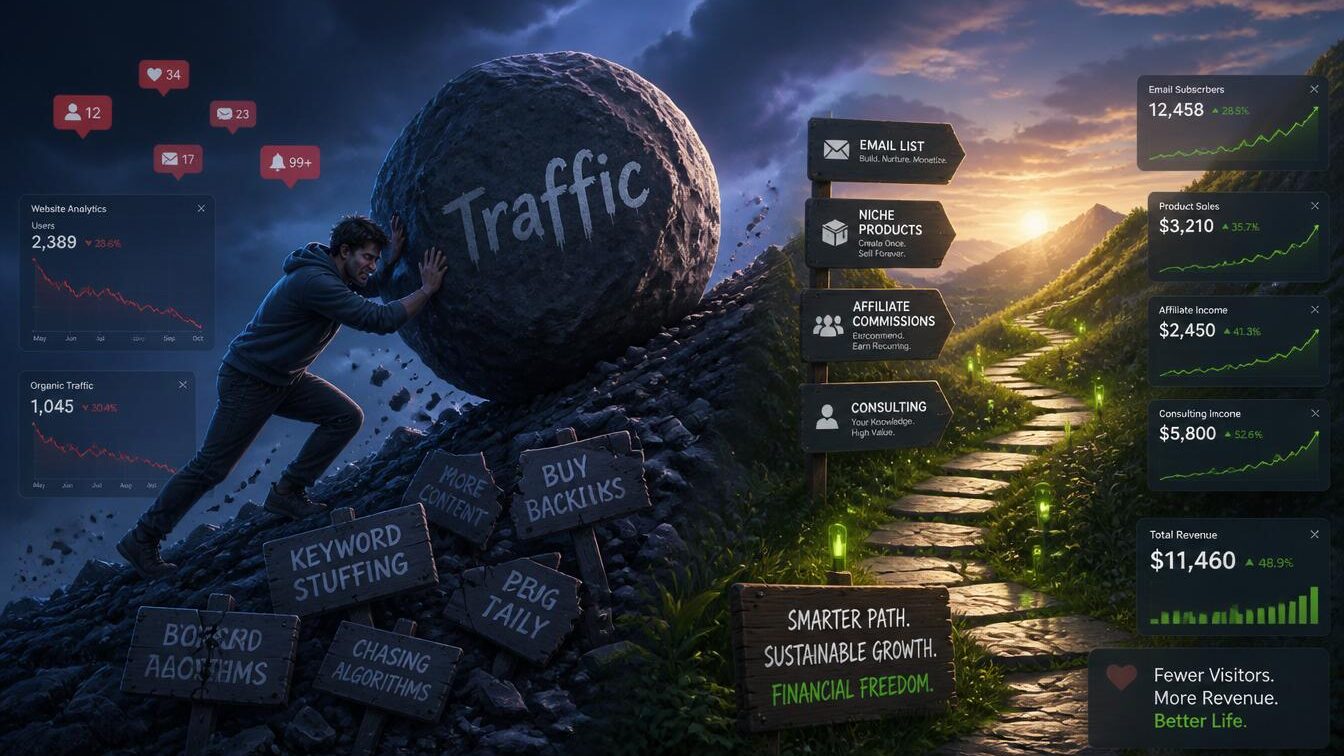
A lot of new site owners quit within six months, and usually it’s because they’re measuring the wrong thing. They see an established blogger pulling in a few thousand dollars a month from display ads and assume that’s the model — publish enough, wait long enough, and the ad revenue shows up. So they write whatever comes to mind, skip any real SEO content strategy, and end up with visitors who read and leave without buying anything.
What they don’t realize going in is just how steep that early climb is. A brand-new site is fighting several battles at once:
- No trust yet. Search engines don’t hand out rankings on day one. They want to see months of consistency, decent security, some signal that you actually know the topic — before they’ll send you meaningful traffic.
- Ads don’t work on a small scale. Display networks need volume to pay out anything worth mentioning. I ran AdSense on a blog getting under 500 visits a month once, purely as an experiment. It made less than two dollars. That’s roughly when I stopped thinking about ads and started thinking about services.
- Trying to please everyone pleases no one.The content you have that doesn’t speak to anyone will not have any conversions. Early on, you’re not trying to attract thousands of casual browsers — you want the few who actually need what you’re offering.
Traffic and Money Aren’t the Same Line
A small, focused audience can outearn a huge, uninterested one — pretty consistently, actually.
| Website Type | Monthly Traffic | Visitor Intent | Revenue Potential |
| General viral entertainment | 10,000 | Casual browsing, low attention | Low |
| Niche industry consulting | 100 | Looking for a specific solution | High |
| Local service or freelance site | 50 | Ready to hire or buy | Very high |
Somebody typing “funny work stories” wants five minutes of distraction. Somebody typing “B2B SaaS copywriter in Chicago” already has a budget and a deadline. Write for the second person.
Four Ways to Make Money Before You Have an Audience
1. Turn Your Site Into a Portfolio, Not a Magnet
With no traffic you should consider your website as a store front that you direct traffic towards — NOT a store front that you wait for traffic to find. Send messages through LinkedIn, join the appropriate Facebook groups, cold email some prospects. The site’s job is just to back you up once someone’s already curious.
I’ve seen this play out with a web designer who ranked for “restaurant website designer in Dallas.” Only about 50 visits a month, but two of them turned into paying clients. Not much traffic — but everyone who showed up was already looking to hire.
Good niches for this: SEO audits, integration of AI, technical writing, and web development, social media management. Create a services page that addresses the buyer’s specific difficulty and include your portfolio and make a contact form as easy to complete as possible.
2. Affiliate Income Doesn’t Need Scale — It Needs Timing
You don’t need a viral post to make affiliate money. You need to be the answer someone finds right when they’re already trying to solve a problem.
Avoid the top 10 gadgets list round-ups — you can’t outrank Wirecutter. Instead, go narrow, such as a step-by-step tutorial on, say, “how to set up a website for a local bakery,” and a natural connection with the actual hosting service and/or the theme you used.
A podcasting-gear tutorial I know of gets under 300 visits a month but converts around 7% of readers into buyers, because everyone landing on it is already halfway to a purchase decision. That’s the whole trick — intent beats volume.
One rule that matters more than any tactic: Only suggest what you have personally used and what you would recommend. After one bad suggestion, they stop listening to any suggestion you make.
3. Small Digital Products Beat Big Ones (At First)
A full course takes months to build and might sit unfinished forever. A template, checklist, or short guide takes a weekend. Digital products cost nothing to reproduce, and even a small one changes how people see you — you go from “person with a blog” to “person who sells something useful.”
Think downloadable spreadsheets, an automation checklist, a short e-book, a content calendar. Think of how much more credibility a well crafted $9 checklist will garner than a hundred blog posts that very few people read twice.
4. Build a List Before You Build an Audience
Algorithms change. Platforms throttle reach. The one channel nobody can take away from you is your email list.
Even with five visitors a day, aim to convert at least one into a subscriber. Don’t have a subscription to my newsletter box – no one does that anymore. Provide a specific alternative: “Download my 5-step template for AI image generation” or whatever the pertinent alternative is in your niche. Once you have someone on the list, you have a first-class line to that person, which is better than relying on the algorithm to show them the right way today.
Stop Publishing Random Posts — Build a Cluster Instead
Scattered articles don’t build authority, no matter how good each one is individually. What works is a topic cluster : one central pillar page, with several focused articles feeding into it.
For example:
- Pillar page: Ultimate Guide to Local SEO
- Sub-topic: Google Maps optimization
- Sub-topic: Schema markup (start with our beginner’s guide, then apply it to local businesses)
- Sub-topic: Local citations
Going deep on one narrow area beats covering ten broad ones. Slow to get started, but what really makes readers and search engines believe you know what you’re talking about.
A Few Things to Avoid
- Ads too early. A web page with 50 visitors a month and banner ads looks like amateur work and makes hardly any money.
- Doing everything at once. Creating a course, running an affiliate program, pitching sponsors and building an agency is a quick way to burn out. Choose one of them and make yourself proficient at it.
- Waiting for perfection. Perfection is not necessary with your logo. The ability to write clearly and without jargon, provide a working link, and have someone pay you.
A Rough Order to Do This In
- Get the basics right. A fast site, a homepage that says clearly who you are and what you do, and an easy way to reach you.
- Write the core content. Three to five solid articles on the specific problems your ideal reader actually has — not generic filler.
- Start collecting emails. Build one lead magnet and get the signup form live before you think you’re “ready.”
- Go find people. Don’t sit around waiting for Google. Post on LinkedIn, answer questions in forums, reach out directly. Your first real traffic usually comes from you, not search.
The Bottom Line
Making money from a new site isn’t about waiting for an audience to show up — it’s about taking the small one you already have seriously. That means paying attention to intent, not pageviews.
Consider your website more like an email engine you are constructing, brick by brick, than a lottery ticket that pays off when Google sees you. Establish good groundwork, win over a few individuals, and make money on purpose. When your organic traffic does arrive, you will already have an audience to whom you can direct it.
Frequently Asked Questions
Can a website really make money with zero traffic?
Yes — if you’re using it as a portfolio to land freelance or consulting work. You’re doing the outreach yourself; the site just needs to close the deal once someone’s interested.
Should I put Google AdSense on a new blog?
Probably not yet. AdSense needs real volume to pay meaningfully. At low traffic, ads mostly just distract the few visitors you do get from things that actually make you money — like subscribing or booking a call.
How long before organic traffic actually shows up?
Most new sites go through a slow stretch — often called a sandbox period — while search engines figure out whether you’re consistent and trustworthy. Six to twelve months of steady publishing is a reasonable expectation, not a guarantee.
What’s the best monetization strategy if I’m just starting out?
Services or freelance work, hands down. One or two clients can outweigh thousands of ad-supported pageviews, and you don’t need to wait on search rankings to get there.

Brilliant advice! Focusing on visitor intent and value over raw traffic volume changes everything for beginners.
True! Helping the right audience matters more than just getting more clicks.