

When you first hear about an on page SEO checklist it sounds a bit tricky. It is really pretty simple. On page SEO has to do with ensuring that the content within your web site is readily comprehensible to search engines. This way they can rank your content higher. The best organic position according to the recent SEO statistics is receiving about twenty seven percent of all the clicks which is an indication of the importance of appropriate optimization.
Importance in 2026 Search Landscape
Search engines have evolved a lot especially with AI powered results and smarter algorithms. Google is no longer merely a search engine that considers keywords it looks at intent and satisfaction to the user. Take into account clearly matching search intent pages and offer structured useful information that are more likely to be ranked higher .
This implies that a good on page SEO checklist is not only about the placement of key words anymore. It is concerned with the development of a powerful SEO content strategy that aims at producing useful, problem-solving and high-value content. Search engines measure the duration your user spends on your page, the interaction of your user with your content and their usefulness.
Your content needs to be done or it will not do well even if you have good links to your website. Without it all other things are feeble. This is why beginners need to learn and use these methods one step at a time to create a foundation for SEO which is important for growth.
On Page SEO vs Off Page SEO Key Differences
What Is Off Page SEO
Before diving deeper into your checklist it is important to understand on page SEO vs off page SEO. On page SEO happens inside your website while off page SEO happens outside your website. Off page SEO includes things like backlinks, brand mentions and social signals that build trust and authority .
Your website is like a student. The work you do on your website to get it ready for search engines, which is like studying and getting ready for exams, is called On page SEO. Then there is off page SEO, which’s like getting good words from your teachers and friends. Both of these things are important for your website.
Core Differences Explained
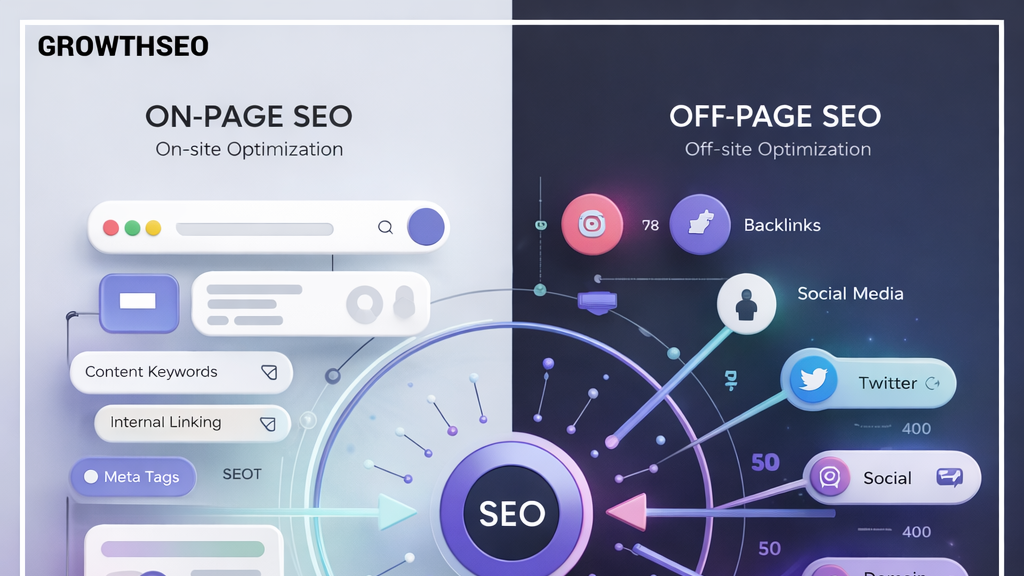
Here is a simple comparison to make things clearer:
| Factor | On Page SEO | Off Page SEO |
|---|---|---|
| Focus | Content and page elements | External signals |
| Control | Fully controlled by you | Limited control |
| Examples | Keywords headings content | Backlinks mentions |
| Goal | Improve relevance | Build authority |
On page SEO helps search engines understand your content while off page SEO helps them trust it . You will need both but in the case of beginners it is always wiser to start off with on page SEO.
Search Intent and Keyword Research
Understanding User Intent
The core of your on page SEO checklist is in keyword research. However, this is where many beginners go wrong. They also do not pay attention to intent and are only interested in keywords. Search intent refers to the reasons why a person is searching something.
As an example when a person types in on page SEO checklist he/she does not want a definition but a guide. Unless what you post is in line with that purpose, your page will not rank, despite utilizing the correct keywords.
The search engines have become very intelligent. They examine the user activity and see whether your page meets the query. In case users do abandon your rankings decline. The longer they remain the better your rankings.
Conduct Proper Keyword Research
Keyword research is not about finding the most popular terms and repeating them throughout your article. It is about understanding exactly how your audience talks about a topic — and finding realistic opportunities to rank.
Start with free and paid tools:
- Google Keyword Planner — free, shows search volume and competition level
- Ubersuggest — beginner-friendly, shows keyword difficulty scores
- Ahrefs or Semrush — more advanced, shows what your competitors rank for
How to find low-competition keywords as a beginner:
New websites have little authority, so targeting high-volume, competitive keywords like “SEO tips” is a losing strategy early on. Instead, follow this process:
- Type your broad topic into Google and look at the “People also ask” and “Related searches” sections at the bottom — these reveal real variations people search for
- Filter for keywords with a difficulty score below 30 in any keyword tool
- Prioritize keywords that are specific and longer — “on-page SEO checklist for beginners 2026” is far easier to rank for than “SEO checklist”
- Check the current top-ranking pages for your keyword — if they are all from massive authority sites like HubSpot or Moz, choose a more specific variation
Where to place your keywords:
- Primary keyword: title tag, URL, first 100 words, at least one H2
- Secondary keywords: naturally throughout the body
- Related terms: in image alt text, conclusion, and meta description
Never repeat the same keyword mechanically. Write naturally and use synonyms — search engines are sophisticated enough to understand related language.
Write a Compelling Meta Description
Your meta description does not directly affect your ranking — but it directly affects whether anyone clicks on your result in the first place. A weak meta description means fewer clicks, which signals to Google that your result is less relevant, which quietly hurts your ranking over time.
The rules:
- Keep it between 150 and 160 characters — anything longer gets cut off in search results
- Use your main keywords in a natural way – Google will highlight the matching terms for you – this attracts the eye to the keywords
- Make a clear promise: state to the reader what you’ll provide if they click
- Write in the style of a short advertisement, not summary
Example:
Moderate: “This article covers on page SEO and its significance to your website ranking.
Strong: Follow this full on page SEO checklist to optimize your content, correct usual errors and boost your ranking in Google in 2026.
One critical rule many people miss: Google will sometimes rewrite your meta description if it doesn’t closely match the content of your page. This happens when Google thinks its own version better represents the page for a given query. To prevent this, make sure your meta description genuinely reflects what is on the page — do not write a description that promises something your content does not deliver. Alignment between your description and your actual content is the best way to keep Google from overriding it
Content Optimization and Quality
Writing Helpful Content
The content is really the important part of your on page SEO checklist. Search engines like content that’s helpful. This content should be informative and easy to understand. Your goal, with the content should be to answer the user query with the content.
For product page SEO, create content that helps customers understand the product and decide whether it meets their needs. Highlight key features, explain benefits, answer common questions, and provide useful details that support the buying decision.
Write in a conversational tone. Use simple language. Deconstruct complicated concepts into simple explanations. Include examples, analogy and real life situations to make your writing interesting.
Avoiding Keyword Stuffing
Keyword stuffing is when you use the keyword over and over in your writing. This makes your writing look fake and spam.
Rather, write naturally and beneficially. Instead of repeating the same keyword several times, employ variations, synonyms and more importantly low competition keywords that suit your topic. These are the keywords that are not as difficult to rank and you can reach the right people without over-optimization.
Heading Structure and Readability
Using H1 H2 H3 Properly
Headings help make your content easy to read. They organize it. Use one H1 for your title, H2 and H3 for subtopics. Headings help search engines understand your content structure. They are like signposts.
Improving User Experience
The content needs to be readable so that users will keep reading. Good readability improves user experience which is a key ranking factor in modern SEO. Long sentences can be very confusing for readers.
URL Optimization
Clean and Simple URLs
Your URL should be short, clear and descriptive. Include your main keyword if possible. Do not use confusing web addresses with numbers or random characters.
A clean web address helps them understand what your webpage is about.
Internal Linking Strategy
Connecting Pages for SEO
Building roads between your pages is what internal linking is about. This is how you help search engines find your content and see how your pages are connected to each other.
Connect related articles with the help of related anchor text. This enhances the user experience and retains customers on your site.
Image Optimization Techniques
Alt Text and Compression
Images really make your content more interesting. You are supposed to use words to explain what is pictured in the images in order that search engines understand what the pictures are.
You should reduce the size of the pictures to ensure that they do not take time to load. They will like it and stay on your website.
Page Experience and Technical Factors
Speed Mobile Friendliness and UX
Page speed, mobile friendliness and overall user experience are really important for rankings. Search engines, like pages that load fast and work well on all devices, including phones.
Here are some tips to improve loading speed:
* Optimize your images
* Reduce code
* Use hosting
This will help your website load quickly and be easy to use.
Conclusion
Having a good on page SEO checklist is similar to having a foundation to your house. In the absence of a robust on page SEO checklist all other things become shaky. By streamlining your content structure and user experience you increase the ease of your page being comprehended by the search engine and makes your page more prominent.
By knowing the distinction between on page SEO and off page SEO, you can see the picture. On page SEO ensures that the content that you have is relevant to individuals that are searching something. Off page SEO gives credibility to your page.
Using this step-by-step approach to on page SEO regularly will result in better rankings and traffic and user interaction. SEO is not a single event that is a process that you must continue doing in order to achieve good results with on page SEO.
Hi! This is my 1st comment here so I just wanted to give a quick shout out and say I truly enjoy
reading your blog posts. Can you recommend any other blogs/websites/forums that
deal with the same topics? Thank you so much!
Hi! Thanks so much — really glad you’re enjoying the posts 😊
I’ve written a few step-by-step guides:
https://growthseo.net/seo-strategies-for-new-websites-a-beginners-guide-to-ranking-on-google/
https://growthseo.net/seo-guides-for-beginners-a-step-by-step-guide/
https://growthseo.net/how-to-find-low-competition-keywords-step-by-step-guide-for-beginners/