A content manager I spoke with recently described a situation most editors now dread.
Her team had published what looked like a solid article — clean writing, logical structure, well-paced arguments. The kind of piece that makes it through review without a second glance. A week after it went live, a reader flagged a statistic. The team went looking for the source. They checked industry reports, research journals, and databases. Nothing turned up. The number hadn’t been lifted from a shady website or garbled by a typo. The AI had simply invented it — confidently, fluently, and without any indication that it had done so.
This is one of the most concerning AI hallucination examples in content publishing. Not bad grammar. Not weak arguments. But hallucinated facts dressed up in authoritative language.
Publishing unverified AI content is one of the most overlooked SEO mistakes to avoid — not because Google punishes bad grammar, but because readers flag inaccurate facts, trust erodes, and rankings follow.
Why Editors Keep Getting Caught Out
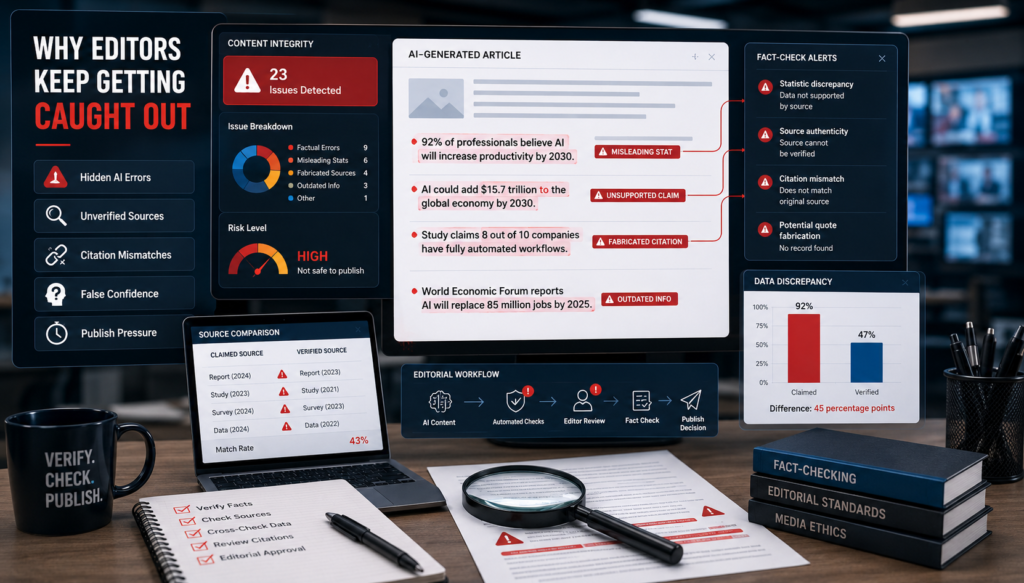
Most editing instincts are trained on style. We’re programmed to correct the clunky sentence, make the transitions, tighten the headline. Those instincts are very helpful — but they don’t work with content generated by AI.
Your sentence is awkward and awkward looking. A fabricated statistic can end a relationship with your audience.
Many teams focus on readability and SEO while overlooking verification. Yet accurate sourcing is becoming a core component of AI visibility optimization, especially as AI-powered search experiences rely on trusted information.
The first pass on any AI-assisted draft should treat style as secondary. Before you touch a single word for tone or flow, ask: is this actually true?
The claims that need scrutiny aren’t always the dramatic ones. They’re the quiet, reasonable-sounding ones — the statistics that seem to confirm what you already believe, the research findings that slot neatly into your argument, the quotes that sound exactly like what that person would say.
Pay particular attention to:
- Statistics and percentages — these are the most commonly hallucinated facts
- Quotes — AI is surprisingly good at mimicking someone’s voice while inventing the statement entirely
- Dates and timelines — easy to get wrong, easy to miss in review
- Research and study references — the study often exists; the specific finding often doesn’t
- Company and product details — pricing, features, and org structures change constantly
The Statistic That Didn’t Exist
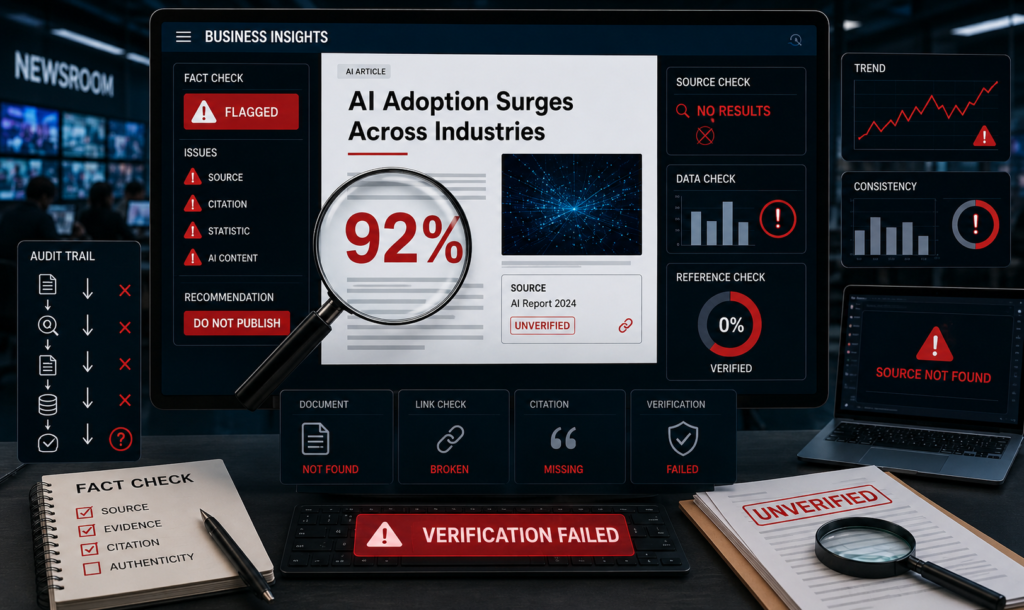
An independent writer I know was writing an article on customer loyalty programs. This was part of the AI draft: 84% of consumers are more likely to stick with brands that have rewards programs.
This is a good sounding number. Plausible, specific, directionally consistent with what most people in marketing believe. In a fast-moving workflow, it would have sailed through.
She ran it down anyway. No study matched the figure. There were legitimate pieces of research on loyalty and rewards — but none produced that number. The AI had apparently synthesized something that sounded like a real finding but wasn’t traceable to any actual source.
The article was corrected before publication. One extra check, twenty minutes of work, and the piece went out clean.
What changed in her workflow afterward? Every statistic gets verified before anything else gets touched. Not because errors are common — but because the ones that slip through tend to be the convincing ones.
Primary Sources Beat Repetition
One of AI’s less obvious weaknesses is that it learned from the internet — which means it learned from a vast amount of content that simply repeats other content. A claim that appears on fifty websites isn’t necessarily true. It may just be widely copied.
When you’re verifying a claim, the question isn’t does this appear online? The question is where did it originate?
The data from government, peer-reviewed research, official company filings, and first-hand interviews are authentic. A blog post that references another blog post that references an article that no longer exists doesn’t.
Sometimes the additional time involved in finding where a claim originated will reveal that the original claim was narrower, older or more qualified than the repeated claim. That context matters. Leaving it out doesn’t make content simpler — it makes it less accurate.
Quotes Deserve a Separate Check
Fabricated quotes are one of the more insidious AI errors, because they’re engineered to pass inspection.
The wording fits the person’s known communication style. The sentiment is plausible. The context makes sense. Everything about the quote signals authenticity — right up until you search for it and come up empty.
In order to be included in an article, any quotation must have a verified source: an interview, a speech, a book, a podcast, a press release, a news source, etc. If you can’t find it, it doesn’t fit in. There’s no grey area here.
A fabricated quote isn’t just inaccurate — it puts words in a real person’s mouth. The reputational cost of that, for both subject and publisher, is disproportionate to the small effort it takes to check.
A Working Fact-Check Checklist
You don’t need an elaborate system. A simple checklist, applied consistently, will catch most AI-generated errors before they reach readers.
| Area | What to verify |
| Statistics | Traceable to an original source? |
| Quotes | Verifiably said, in a locatable context? |
| Dates | Accurate and current? |
| Research | Does the cited study actually support this claim? |
| Company details | Is this still true? (Funding, leadership, products change) |
| Product specifics | Features, pricing, and availability confirmed? |
| Sources | Credible, recent, and primary where possible? |
Build Verification Into the Process, Not Onto the End
Teams that handle AI content well don’t fact-check as a final step. They build it into the sequence so it can’t be skipped when deadlines get tight.
A workflow that holds up in practice looks roughly like this:
- Generate the draft
- Identify every factual claim before editing anything else
- Verify statistics and research findings
- Confirm all quotes with a locatable source
- Check dates, company information, and any figures that could have changed
- Edit for voice, clarity, and flow
- Final review before publishing
The order matters. How convincingly-written errors get into print is by editing style before checking facts.
Frequently Asked Questions
Is AI-generated content generally reliable?
Often, yes — but “often” isn’t good enough for publication. AI can produce largely accurate content and still contain one fabricated statistic or invented quote. That single error is the one readers will find.
Where should I start?
Statistics and quotes first. They’re the most likely to be wrong and the hardest to catch by feeling alone.
Why does AI invent facts?
It doesn’t explain what’s true — it predicts what text is likely to follow other text. That process produces accurate-sounding output most of the time. When it doesn’t, there’s no internal warning signal. The hallucinated fact arrives with the same confidence as the correct one.
How long should fact-checking take?
A typical blog post: 20–30 minutes. Anything touching medical, financial, legal, or technical claims should be budgeted considerably more time.
Can AI fact-check its own output?
It may point out possible problems and provide search terms, but it does not necessarily confirm what it says. The only kind of verification that matters is independent from real sources.
The Bottom Line
AI has made the first draft faster. It hasn’t made the editor less necessary.
Readers don’t know or care how an article was written. They care whether it’s accurate. They will check the stat that surprises them. They will notice the quote that doesn’t match the record. And when they find an error, they won’t distinguish between “the AI made that up” and “this publication doesn’t verify what it publishes.” Those are the same thing to them.
If the content that it produces cannot be trusted, then it seems like speed is not an advantage.
Those publishers who will do the work to develop loyal readers will be the ones who make verification a professional routine and not a nice-to-have. With the current landscape of AI-powered content, one thing stands out as a true differentiator: reliability. With so much AI-generated content around, reliability is one thing that still sets an excellent source apart from the rest.
Every verified fact is a small deposit into that account. Every unchecked claim is a withdrawal.