
Starting a website is really exciting. It can be hard to get people to find it on Google at first. SEO is here to help. It makes your site show up in search results when people look for things like what you have on your site. For beginners, understanding on page SEO for beginners is one of the most important steps to improve visibility and rankings.
Why SEO is Important for New Websites
Lately, it is exciting to launch a new website, but it can be difficult to get any visitors. New domains do not have authority, meaning it will take time for search engines to find, understand and trust your content. Even if you write a great article, it can fail to show up in search results if you don’t have a solid SEO strategy.
With SEO, your web page becomes more visible to the search engines because of its visibility from the search engines perspective. Your content will have more of a chance of being found by those that are seeking information about your niche when it’s optimized and offers value.
Effective SEO helps search engines:
- Discover and index your pages more efficiently.
- Understand what each page is about.
- Recognize your website’s expertise within a specific niche.
- Match your content with the right search queries.
- Improve your visibility in organic search results over time.
Unlike paid advertising, SEO can continue driving organic traffic long after your content is published. Although results are not immediate, investing in SEO from the beginning creates a strong foundation for sustainable growth and long-term success.
How Google Evaluates New Websites

When a new website is launched, Google doesn’t automatically know whether it provides reliable or helpful information. Google’s algorithms must first find your website, determine what it’s about, and assess the quality of your website before they rank your pages.
Google relies on many ranking factors to identify which pages are worthy of being shown in search results. The specifics of the algorithm are not public, but there are some features which are particularly relevant for new websites.
For new sites, Google looks for:
- Clear niche focus
- Helpful, original content
- Consistent publishing
- Natural backlinks
- Positive user experience
- Master Search Intent to Deliver Highly Relevant Content
- Keep Content Fresh with Regular Updates and Improvements
You want to show Google that your website is a place to visit. This means you need to make sure your site is reliable and has information on it.
SEO Strategy #1: Choose a Clear Niche and Topic Focus
The number 1 mistake that new website owners make is that they write about multiple topics that are not really related to each other. If the content of your website is about more than one thing, it can be hard for search engines to determine your website’s niche. When you have a niche, it will help Google see that you know more about a particular subject than anyone else; and with time, you can establish topical authority.
First, select one main topic that relates to what you know, like or have a business interest in. Then write several articles that discuss various aspects of this topic. Don’t publish everything, cluster articles into groups around the same topic and link them together with internal links.
New websites get a rank faster if they focus on just one main topic. This is better than trying to cover unrelated subjects.
Example niche clusters:
- SEO guide for beginners
- Affiliate marketing
- Online business ideas
- Blogging strategies
Topical focus helps Google understand your authority.
SEO Strategy #2: Do Low-Competition Keyword Research
The first step in any successful SEO campaign is keyword research. If you are building a new website, attempting to get high competition keywords is probably a bad idea since high competition keywords have already been optimized by high ranking websites. Rather, target long-tail keywords with less competition, that have clearly defined search intent and are easier to rank.
Long tail keywords are more specific search terms that tend to have less competition, and are probably the ones that visitors will actually search for if they know what they want. While they might have less traffic, they often have more engagement as they align better with what users are looking for.
New sites should target keywords with:
- Low competition
- Specific intent
- Beginner questions
Examples:
“SEO tips for new websites”
“how to start SEO blog”
“SEO checklist for beginners”
You need to use long-tail keywords to get a rank, on search engines.
SEO Strategy #3: Focus on Helpful Content That Fully Covers the Topic
Producing beneficial and complete content is among amongst the greatest methods to boost your search engine marketing. Google’s goal is to serve pages that satisfy users’ queries and give them a great experience. Don’t produce short articles that only touch the surface, focus on producing material that won’t make readers look elsewhere.
Know the purpose of your target keyword’s search. Consider what information users are interested in and what problems they want to solve. Next, structure your article in a logical manner and explain and illustrate each step of the topic.
Your articles should:
- Answer real questions
- Explain clearly
- Provide steps or examples
- Be easy to read
- Avoid thin or AI-only content. Add your insights and experience.
SEO Strategy #4: Optimize On-Page SEO Basics
On page SEO makes it easier to understand what your page is about, and makes the site better for visitors. Before publishing any page of your website, you must do some optimisation.
Every blog post should include:
- Keyword in title
- Keyword in H1
- Keyword in first paragraph
- Related keywords in H2s
- Internal links
- Meta description
But, don’t overuse keywords. Your content should be natural, and user-centric rather than search-engine-centric.
Besides using keywords, organize content for easy reading. Make sure to use descriptive headings, short paragraphs, bullet points and pictures with descriptive ALT text. These factors help to make your content more scannable and comprehensible.
Remember to include internal links to relevant articles on your site, and external links to reputable sources when applicable. Links from within the article can lead search engines to find more of your articles, and if you have links from relevant external articles, it can make your article more useful.
SEO Strategy #5: Build Internal Links
Internal linking is one of the simplest and best online marketing techniques for new websites. An internal link is a link between the pages of a website. These links allow search engines to find new pages, learn the structure of your content and see which pages are most significant.
For instance, to write a guide on keyword research you can naturally link to other keywords that are related to on-page SEO, like a checklist of on page optimization, SEO writing tips and low-competition keywords for keyword analysis. This makes the logical structure of your content that will help your users and search engines navigate your site.
When linking internally, include words that describe the content you are linking to rather than vague terms such as “click here. For instance, replace read more with low competition keyword research guide. This gives background information on the page you are linking to. When your website expands, go over older articles and link them to your new material. This helps to keep older pages useful, and helps to spread your site’s authority.
Example:
SEO basics → keyword research → on-page SEO
Blogging → content strategy → SEO writing
This builds topical authority over time.
SEO Strategy #6: Build Authority by Following Google’s E-E-A-T
Google is looking for pages that can be trusted. One method it uses to assess content quality is by considering the metrics E-E-A-T (Experience, Expertise, Authoritativeness, and Trustworthiness). E-E-A-T isn’t a ranking factor, but it’s included in Google’s quality evaluation guidelines and can impact the content’s perceived quality.
E-E-A-T is a process that takes time to build, particularly for new websites, but you can begin establishing trust from the get-go by creating accurate, helpful and original content.
To gain authority, your website should show:
- Experience: Real insights or examples
- Expertise: Accurate SEO knowledge
- Authoritativeness: Niche focus
- Trustworthiness: Transparent info
- Add trust signals like:
- Author bio
- Contact page
- Consistent branding
These increase credibility for new sites.
Common SEO Mistakes New Websites Should Avoid
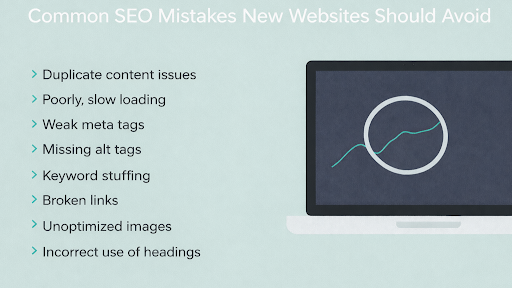
Creating a new website requires some time and it is not unusual to make errors while developing it. But, you can avoid common SEO mistakes and ensure that your website has a faster growth rate and there are no unnecessary ranking problems. Most of the newcomers are interested in the fast growth rather than establishing a good base and that’s why they may find the results to be disappointing.
Here are some of the most common SEO mistakes new website owners should avoid:
1. Targeting Highly Competitive Keywords Too Early
New sites typically don’t have the authority to rank for ‘big keywords’ with large volumes of traffic. Rather, target low-competition, long tail keywords that have less competition but are more likely to align with the intent of your audience.
2. Publishing of Thin or Low Quality Content
Articles that have little value and/or only briefly cover a topic have less chance of ranking. Develop in-depth and original articles which respond to users’ queries, provide examples and deliver unique insights.
3. Ignoring Search Intent
The content can be well written, but still fail to perform if it doesn’t align with what users are searching for. Know the intent behind the search before writing an article by studying the search results to determine if the people are looking for information, a product, or a service.
4. Neglecting Internal Linking
Inside connections allow search engines to index your pages, otherwise they might not be indexable, and visitors may not find the related material. Use anchor text that describes the articles you are linking to and build topical authority for the links.
5. Publishing Random, Unrelated Topics
Articles that are unrelated to the website’s niche won’t help boost its search engine ranking.Articles that are not related to the website’s niche won’t do much to improve the search engine ranking. Choose one niche and write articles within a very similar scope to build your reputation.
6. Forgetting On-Page SEO
Your page might not be as visible if it lacks title tags, isn’t optimized for images, or has duplicate headings and meta descriptions. Check all articles before publication for adherence to basic on page SEO.
7. Expecting Instant Results
SEO is a long term process particularly for new websites. Search engines take time to assess your content and rankings can take several months to start improving. Be consistent and value driven rather than results oriented.
If you can avoid these pitfalls and tweak your content for improvement, you’ll have a better base on which to sustain your organic growth.
Final Thoughts:
Having a new website and growing it via SEO takes time, consistency, and a commitment to help your audience. While there’s no quick and easy way to achieve the success you want, if you stick to some trusted SEO SEO best practices, you’ll have a better chance of reaching the top of search engine results pages over time.
Do not go for all the keywords, but rather concentrate on the authority building in the particular niche. Generate quality articles that address actual questions, optimize each page for both search engines and visitors, build useful internal links and adjust articles over time with new information.
Above all, put your readers first. When your content actually helps solve problems, shows expertise and offers value beyond what other people are already providing online, SEs will see your website as a valuable resource and trustworthy site.